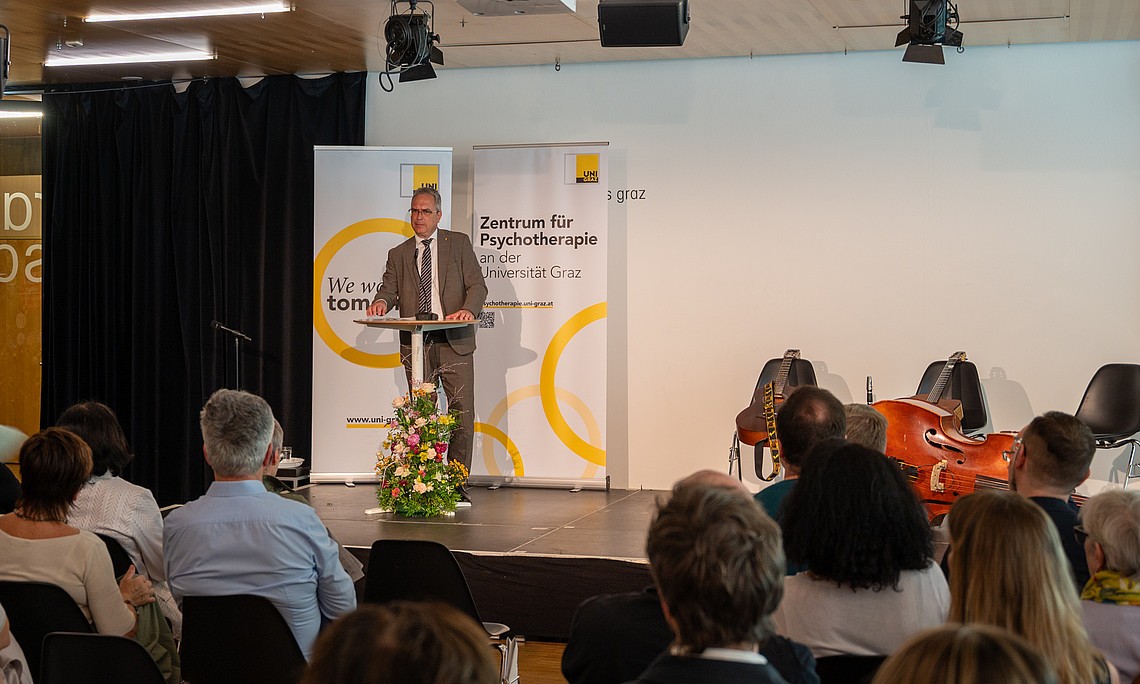
Uni Vibes: Where science and art come together

Protest against budget cuts: universities send a united message in Graz

On 28 May, thousands of students, researchers and staff from all Styrian universities demonstrated in Graz against the announced budget cuts. University management and student representatives warned of severe consequences for research, teaching and the region’s standing as a centre of academic excellence.

Overcoming boundaries: Can we manage without prisons and camps?

The US immigration agency ICE has sparked fear and horror. Not only are migrants criminalised and brutally persecuted, but earlier this year, ICE officers killed two US citizens in Minneapolis. Against the backdrop of these dramatic events, the University of Graz is shedding light on the role of deportation and detention centres as part of the international conference ‘Camps, Belonging, and Abolition Democracy’. Researchers aim to develop scenarios for how a future without prisons and the death penalty can become a reality.

From one to many: Uni Graz researchers identify a mechanism for the origin of species

When a habitat changes, animals, plants and even humans must adapt to the new environmental conditions. Those who manage this fastest and best will prevail. Over time, new species that are specialised for specific habitats also develop. Zoologist Christian Sturmbauer and his research group at the University of Graz, together with international partners, have now demonstrated that the molecular biological process of “alternative splicing” – contrary to previous assumptions – contributes highly effectively to the formation of new species. Different combinations of parts of the same gene give rise to various, structurally slightly different variants of functional proteins. This leads very rapidly to significant changes. The research findings were published in the renowned journal Proceedings of the National Academy of Sciences.

Open doors for open science: Psychology quartet “GOSI” initiates forum on research practic

Scientific results that are free, accessible and transparent for everyone. The advantages of open science are obvious. And yet, many researchers still feel uncertain and sceptical. A team of young scientists at the University of Graz – the Graz Open Science Initiative (GOSI) – wants to do more than just dispel these doubts. It also wants to highlight weakness and reservation and create a forum for interested people. A project of the Research Careers Campus is supporting the initiative of the four psychologists.