Begin of page section:
Page sections:

  • Go to contents (Accesskey 1)
  • Go to position marker (Accesskey 2)
  • Go to main navigation (Accesskey 3)
  • Go to sub navigation (Accesskey 4)
  • Go to additional information (Accesskey 5)
  • Go to page settings (user/language) (Accesskey 8)
  • Go to search (Accesskey 9)

End of this page section. Go to overview of page sections

Begin of page section:
Page settings:

English en
Deutsch de
Search
Login

End of this page section. Go to overview of page sections

Begin of page section:
Search:

Search for details about Uni Graz
Close

End of this page section. Go to overview of page sections


Search

Begin of page section:
Main navigation:

Page navigation:

  • University

    University
    • About the University
    • Organisation
    • Faculties
    • Library
    • Working at University of Graz
    • Campus
    Developing solutions for the world of tomorrow - that is our mission. Our students and our researchers take on the great challenges of society and carry the knowledge out.
  • Research Profile

    Research Profile
    • Our Expertise
    • Research Questions
    • Research Portal
    • Promoting Research
    • Research Transfer
    • Ethics in Research
    • Commission for Scientific Integrity
    Scientific excellence and the courage to break new ground. Research at the University of Graz creates the foundations for making the future worth living.
  • Studies

    Studies
    • Prospective Students
    • Students
  • Community

    Community
    • International
    • Location
    • Research and Business
    • Alumni
    The University of Graz is a hub for international research and brings together scientists and business experts. Moreover, it fosters the exchange and cooperation in study and teaching.
Topics
  • Sustainable University
  • Researchers answer
  • Work for us
Close menu

End of this page section. Go to overview of page sections

Begin of page section:
You are here:

University of Graz News Fair distribution: Researchers determine just greenhouse gas budgets for all EU regions

End of this page section. Go to overview of page sections

Wednesday, 10 December 2025

Fair distribution: Researchers determine just greenhouse gas budgets for all EU regions

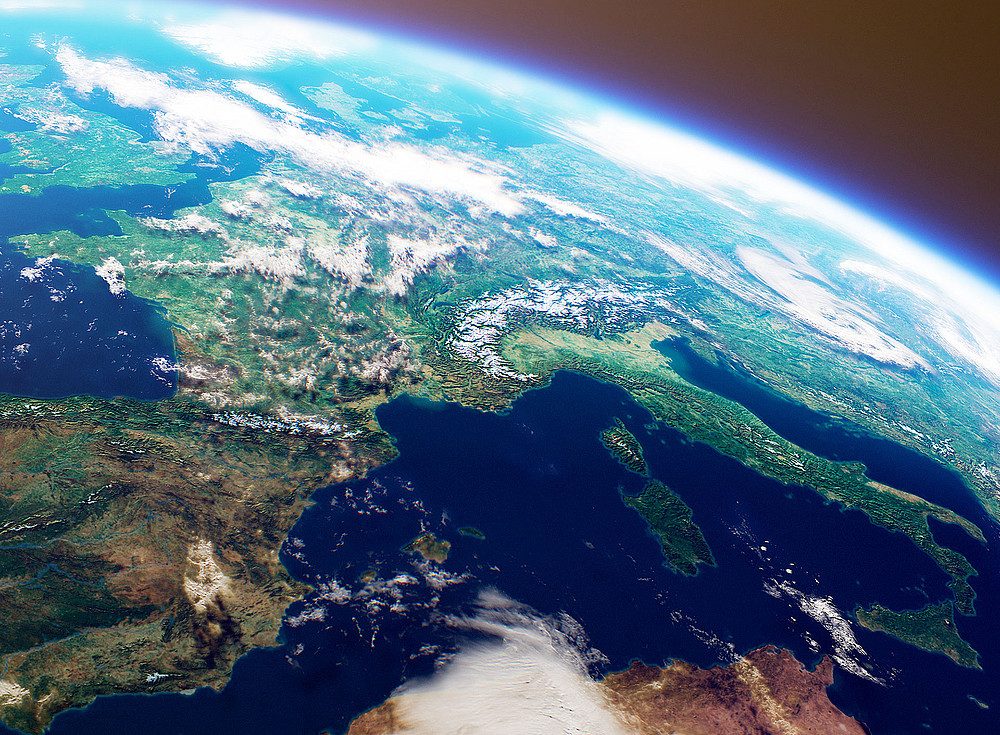
Satellite image of Europe ©drgost - stock.adobe.com

When allocating carbon budgets, the researchers take into account the different economic structures of the regions and their specific risks in the transition to a climate-neutral economy. Photo: drgost - stock.adobe.com

Ten years ago, on 12 December 2015, the Paris Climate Agreement was signed at the UN Climate Conference. In order to limit global warming to well below two degrees, only a certain amount of CO2 may be emitted worldwide. While the focus was originally on national emission targets, more than 200 subnational regions and almost 300 cities have now adopted their own targets. But how many emissions are they fairly entitled to? Researchers at the University of Graz have now developed transparent criteria for fair distribution at the subnational level for the first time and determined corresponding greenhouse gas budgets for all European regions. The paper was published today in the scientific journal Nature Communications.


Do the emission targets set by regions and cities correspond to a fair distribution of the global greenhouse gas budget still available? Or are some perhaps claiming too much for themselves? A research group led by Karl Steininger, climate economist at the Wegener Center at the University of Graz, has developed a framework to calculate this.

Production- and consumption-based emissions
“We assume that every individual in a country has the same right to welfare benefits from emission-generating activities. We then distinguish between consumption- and production-based emission budgets,” says Teresa Lackner, lead author of the publication, summarising the basis for the new framework.
For CO2 caused by the domestic economy and industry, the scientists introduce the so-called “Equal Transition Opportunity Production-Based Allocation” (ETOPA). “ETOPA is a mechanism for allocating production-based emissions fairly at the subnational level. It takes into account different regional economic structures and risks in the transition to a climate-neutral economy. After all, distributive justice in the greenhouse gas budget also means that all regions have equal opportunities,” Steininger emphasises.
Emissions associated with the consumption of a country's population are largely not generated in the country itself, for example when the components for a smartphone are produced on another continent. To be fair, however, they must also be taken into account. “For the distribution of a national consumption-based emissions budget across regions, we propose a qualified, equal per capita allocation that takes into account regional basic needs, historical responsibility and advantages from previous emissions. This has not been sufficiently the case to date,” says the climate economist. As an example of ways to reduce consumption-based emissions, Steininger cites the revision of building regulations: “New requirements, such as the mandatory use of climate-neutral cement, could bring significant savings.”

Research with and for practical application
The framework for the equitable distribution of the remaining greenhouse gas budget among the regions was developed and discussed with Austrian cities. “Positive feedback, such as from the city administration of Linz, confirms that transparent, comprehensible criteria are helpful in arguing for emission reduction measures, also to counter accusations of greenwashing,” reports Steininger. In addition, the publication emphasises that subnational effort-sharing is a political process and needs to be negotiated among national and subnational policymakers in participatory settings including non-state actors such as industry, civil society and communities to be feasible and gain public support. The distributive justice framework and analysis of Lackner et al. may serve as a useful starting point.

Publication
Applying fairness in subnational carbon budget allocations
Teresa Lackner, Lukas H. Meyer, Stefan Nabernegg, Karl W. Steininger & Keith Williges
Nature Communications (2025)
https://doi.org/10.1038/s41467-025-66802-9

created by Gudrun Pichler

Related news

The digital world of tomorrow: University of Graz works with people to shape the future

Digitalisation is supposed to make everything better: artificial intelligence that even organises travel. The car that drives itself. Robots that care for us in our old age. But what kind of future do people actually want? What role should technology play in this? The University of Graz is exploring these questions through a new research facility. At the Graz Sociodigital and Participatory Futures Studio – or GraSP Futures Studio for short – young and old work together with researchers to design visions of the future that also critically examine technical innovations.

Eurovision: Why the Song Contest is always political

The 2026 Eurovision Song Contest sits at the intersection of music, geopolitics and culture. Josef Mühlbauer from the University of Graz explains why the ESC has always been a reflection of European politics, and how this major event highlights cultural affinities and social change.

Superti-Furga will becomefounding director of the CORI Institute in Graz

The Austrian Academy of Sciences (ÖAW) is establishing a new flagship centre for research into metabolic diseases in collaboration with the three universities in Graz. This innovative research approach combines mathematics and experimental biology with artificial intelligence

A match for life

Stem cell donations save lives. However, the only way to determine who is ultimately compatible with whom is through a testing process. Pharmacist Marion Mußbacher explains the mechanisms behind this. On 6 May 2026, the ÖH and the charity “Geben für Leben” are calling for people to come forward for typing at the University of Graz.

Begin of page section:
Additional information:

University of Graz
Universitaetsplatz 3
8010 Graz
Austria
  • Contact
  • Web Editors
  • Moodle
  • UNIGRAZonline
  • Imprint
  • Data Protection Declaration
  • Accessibility Declaration
Weatherstation
Uni Graz

End of this page section. Go to overview of page sections

End of this page section. Go to overview of page sections

Begin of page section:

End of this page section. Go to overview of page sections